Transition on the IEP means
the parents, teachers, other team members,
and most importantly, the student start to think about
and plan for what happens after high school graduation.
After high school graduation
is now called post-school years.
Transitions may look different
for deaf and hard of hearing students.
Some may plan to work right after high school,
others plan to attend college
and need to learn about disability services,
and others might attend a transition program
before turning 21.
Self-advocacy skills and language need
to continue to be strengthened.
However, self-realization is a process
throughout lifetime.
It's important to remember that this happens in stages,
sometimes starting in middle school
or even high school.
For those students who receive little direct service time
from a teacher of deaf/hard of hearing,
it is important to think about information they need
in different places,
such as work and college.
Students may also need more frequent contact
from a teacher of deaf/hard of hearing
in their junior and senior years
when they need to learn about scholarships,
disability services,
programs and colleges for deaf
and hard of hearing students
as well as receive instruction about
how to communicate their needs.
For other students, they may need
to have work experiences
to help them figure out what type of work
they would like to do after high school.
Students may need help planning and practicing
and writing down words to say during the work day
and how to connect with coworkers
and advocate on the job
for interpreters or CART and other services.
Some hard of hearing students in middle school
and early high school years
stop using assistive listening devices in the classroom
and prefer to only wear their personal hearing aids.
They do not want to look different,
especially if they are the only
hard of hearing or deaf student
in class or even in the school.
In middle school and 9th and 10th grades,
sometimes students turn down support
so they feel more independent.
They may also feel more fatigued from listening
and not do as well academically.
During those years, social connections
and appearances are more important.
As they mature, they may be more interested
in remote captioning,
using an assistive listening device in specific classes
especially when they are thinking about
and visiting colleges, vocational training programs
or work situations
that require them to be more responsible
for information they are learning.
It is important that students in middle school
and high school
continue to have different demonstrations
and trials happen in classrooms.
Sometimes they do not want to try specific services
in high school,
but are interested about that service in college.
The pace and rigor of college classes,
as well as some advanced or
honors high school classes,
may cause teams to reconsider what access is available
and services, such as remote captioning,
may need to be added.
Many schools are using teacher-created videos
that are streamed into classrooms.
Sometimes these are called flipped classrooms.
This means the teacher videotapes the lesson
and the students watch it at home.
Even students who say they can hear videos
without captions
should still have captions,
especially when they are learning
new academic vocabulary.
They cannot recognize words that they struggle
to hear fully.
This is an adaptation that should be discussed
on the IEP team.
It is also important that students ask
disability services in colleges
about captions for online videos for different classes.
It is important students and parents understand laws
that relate to training and work after high school.
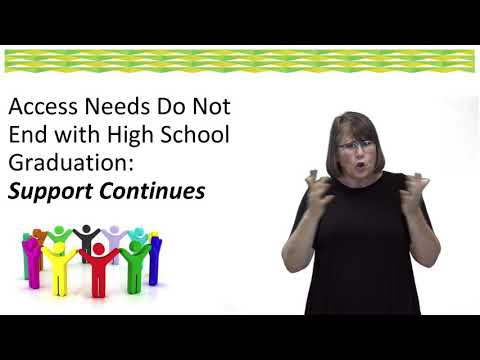
Support and encouragement does not end
at high school graduation.
Students need to be able to explain the challenges
they have in classrooms for disability services in college
as well as for the Department of Employment
and Economic Development (DEED)
which some students also call Department of Vocational Rehabilitation (VRS).
Students at all levels benefit from role-playing
to prepare them for different scenarios
in college and on the job.
High school students often know
that they should advocate
or say something, but they don't know what to say.
This also includes students in honors
or advanced placement courses.
Although they may succeed academically,
they continue to need a wide variety
of advocacy language modeled for them.
Teachers of deaf and hard of hearing students
can provide many resources to students
and their families,
including modeling communication
with disability services
and making connections
with vocational rehabilitation counselors.
It helps teams to think about different items
that students need to know to prepare
for post-school years.
Review the sample transition checklist
that Metro Deaf School created in Appendix VI,
also found on page 46,
to help students create a portfolio.
That portfolio can be modified depending
on the student needs.
The Minnesota Commission for Deaf,
Deafblind and Hard of Hearing's
transition-age collaborative group
produced a transition guide
with webinars which are also a good resource for teams.
Check out this link.
We hope that the prompts from the transition section
will help parents and teachers on IEP teams
to plan for the future,
starting in middle school.
We also hope this helps the student
and others
to understand that transition is a process.

Không có nhận xét nào:
Đăng nhận xét