Thứ Tư, 29 tháng 8, 2018

Auto news on Youtube Aug 29 2018

why does your dog eat their own poop now it might seem like a mystery but in this

video we're not only going to discuss why but we're gonna discuss how you can

stop your dog eating their own poop I

Hi, I'm Dr Alex from our pets health helping you and your pet to live a

healthier happier life and in this video we're going to discuss this really

disgusting habit so it's actually quite common and that problem is dogs eating

their own poop now it might be a complete mystery to you and you might

have tried a number of strategies to try and stop your dog doing this but

thankfully there are a couple of reasons that we think that dogs eat their own

stools and there are some great strategies that we can use so in this

video I'd like to introduce you to Jason Smith from Petco professional pet care

and he's going to talk to you all about why dogs eat their own poop and how you

can stop your dog eating their own poop so without further ado is over to Jason

hi folks Jason Smith here from pet Corps professional pet care thank you dr.

Avery for this opportunity to talk to your audience today you know for over 11

years I've been helping people improve life for their families and pets pet

core does this with our dog waste removal service and Pet Sitting service

today I'm here to talk to you about Co profit

now coprophagia is a fancy word for a very disgusting habit that many dogs

have eating their stool as disgusting as it may seem

copra Aegeus seldom does any harm to your dog's but what causes it there are

three main reasons for copra fujian dogs number one is medical number two is

behavioral and number three is nutritional let's take a moment and

examine the medical issues that may arise that caused coprophagia in animals

the first reason is exocrine pancreatic insufficiency the second one is

pancreatitis the third one is intestinal infections the fourth one is mal

absorptive syndromes and the last one is over feeding especially foods that are

high in fat content now because of these medical issues the

very first thing you should do when you first notice that your dog starts eating

its waste or the waste of another animal is to talk with your veterinarian now I

am NOT a doctor so I cannot go into great detail about these issues but I'm

sure that dr. Avery can go into much greater detail than I regarding these

medical reasons let's move on to the behavioral reasons now there are many

behavioral reasons that are hypothesized by by experts in the field as to why

dogs will engage in coprophagia the first behavioral reason is attention

seeking behavior some dogs when they don't feel like they're getting the

attention that they need will start eating their dog waste as a result

owners will often correct them and this negative attention is still attention to

the animal some people would suggest that you should simply ignore the

problem in hopes it'll go away but we will talk about some other solutions

later on in this video the second behavioral reason is mimicry

this is a learned behavior for some dogs some dogs that spend time in a shelter

situation may observe another dog in the shelter eating its waste or the waste of

another animal and as it notices this it picks it up and adopts this behavior as

its own at home if you're a good pet owner and you clean up after your dog

every time it goes there's a good chance your dog will begin to associate this

idea that when the waste comes out it gets cleaned up and so by understanding

this your dog will begin to help keep the yard clean and the only way it knows

how which is eating the waste the third behavioral reason is maternal

now this is an instinctive behavior of mother dogs they will intuitively clean

off the bottoms of their pups and keep their nesting area clean doing so keeps

predators at bay because as a mama dog we certainly don't want predators coming

into our nesting area while our puppies are vulnerable the fourth behavioral

reason is dominance behavior so some dogs

are trying to assert themselves as the alpha dog and so what they'll do is

they'll adopt the attitude of I'm top dog so I'm gonna eat your waste and

that's how they will assert their dominance over non dominant dogs the

last behavioral reason that dogs engage in coprophagia is reinforcement behavior

basically what this means is that the dogs begin to develop a taste for the

waste dogs will begin to eat their waste they'll develop a palate for the waste

and once they realize that the dog waste is actually pleasing to them they will

continue to do it because it lights up the positive reinforcement centers of

their brain and they continue to do this behavior somewhat compulsively

now the final reason that dogs will engage in coprophagia is nutritional

what this means is that you may be feeding a low-quality food or it has

inadequate nutrition for them or it's simply an unbalanced diet altogether

what you can do is upgrade your food to make sure that your dog is getting all

of the nutritional requirements that it needs and that it has a balanced diet so

what can be done to stop copra Faiza there's no one reason that anyone seems

to agree on but one that absolutely works every single time is to clean up

after the dog why does this work well first of all if there's no waste in the

yard there's nothing to tempt your dog to eat it so it's very important that if

you want to stop copra Faiza that you clean up after the dogs every time they

go when I used to work in a clinic many years ago we would get the question all

the time about what can I do to stop my dog from eating its waste and vet

clinics do have some products that they can give you to help make the waste

unpalatable but what is often cited as a means to make waste unpalatable is

simply adding meat tenderizer to the dog's food other things that you could

add to the dog's food to make the waste unpalatable is pineapple or pineapple

juice now there's this other idea about making waste

palatable and that is simply running out into the yard and sprinkling hot sauce

on the waste now let's be honest if you're gonna take the time to go out in

the yard and sprinkle hot sauce on the waste wouldn't it be better to just

clean it up instead now like I said before copra Fei Jia will sell them to

your dog any sort of harm but there's one thing that all pet owners need to be

worried about and that's parasites now if your dog if you take them fruit if

you take your dog for a walk along your neighborhood or you take them down to

the dog park and your dog engages in copra Fujiya by eating the waste of

another animal your dog could come in contact with parasites such as roundworm

or hookworm and in the case that your dog is eating your cat's waste right out

of the litter box there's a chance that your dog could become infected with a

parasite known as Toxoplasma gondii which causes the disease toxoplasmosis

in your dog in light of this it's often suggested that you train your dog to

avoid the waste altogether so if you notice that your dog is going towards

waste they need to know the leave it command you can teach them leave it it's

going to require a great deal of persistence on your part and consistency

over time to teach them this command so that they do not go near the waste when

they listen to you and they do not go near the waste you need to reward them

as positively as you can it would not hurt to also add a recall command into

the mix now if you don't know how to do this my recommendation would be to work

directly with a professional dog trainer well I hope you found this video to be

very helpful in solving your dog's nasty habit to find out more about pet core

professional pet care and what we're doing to improve life for families and

pets head on over to our channel and check us out okay so big thanks to Jason

for all that great information and I'm sure a number of those strategies will

really help you stop your dog eating their own poop and really get to grips

with this disgusting habit if you've got any questions then please leave me a

comment down below and also make sure that you

check out Jason and pet core professional pet care in the link that I

leave just down here somewhere and until next time I'm dr. alex from our pets

health because they're family

For more infomation >> Why Do Dogs Eat Their Own Poop: and how to STOP it! - Duration: 8:58.

-------------------------------------------

Why Do We Waste Perfectly Good Food In The U.S.? | AJ+ - Duration: 14:35.

This is me dumpster diving to find food for tomorrow's dinner.

Look what I found!

This is a beautiful strawberry.

Why would someone throw this away?

And this is my face after finding some unexpired steak in the trash.

Why am I doing this?

Because we in America have a crisis:

We throw out way too much perfectly good food.

This is like a pristine cookie.

Forty percent of all food in the U.S. goes to waste. That's 400 pounds of wasted food per American per year.

And this is fully edible food we're talking about.

Wowww.

In developing countries, most food waste happens either on the farm or before the

food even makes it to the supermarket. In the U.S., it's a different story.

Not only do supermarkets and restaurants waste a ton of food,

but consumers like you and me waste a lot more.

We're actually the single biggest source of that waste.

Hi, my name's Yara. And I'm also part of the problem.

I buy a lot of groceries and sometimes I just don't eat them all in time.

You know, life just kinda gets in the way.

But here's what's really messed up.

While we waste all of this food,

one in eight Americans is going hungry. That's over 41 million people.

So all this got me thinking: why do we waste so much perfectly good food?

How can we rescue it for those of us who don't have much to eat?

And what can you and I do to cut back on waste in our own homes?

To fully grasp just how much food we actually waste ...

Hi Janet! This is Yara.

I tracked down a group of expert dumpster divers ...

I see them. They're right there.

... who live off what they find in the garbage

Wait, oh my God, I think we found them.

So I joined them to go rummaging through New York City's trash.

They call themselves "freegans,"

And their lifestyle philosophy of "freegan-ism" is completely opposed to what they call ...

This wasteful, destructive, violent, unsustainable ...

That supposes that we have infinite resources when the opposite is clearly true.

That's Janet.

She's one of their organizers.

The main feature of "freeganism" is to encourage people to buy as little as possible ...

and instead rely on salvaging, scavenging and foraging through the trash

to find what you need while cutting down on waste

– which is what we did.

We've found a pile of trash.

The amount of perfectly edible food we found was unbelievable, especially baked goods.

This is my favorite health loaf.

From bagel shops ...

It's not a goldmine, it's a typical night.

cafes ...

Whoa, this is a scone.

And purveyors of expensive cookies.

It tastes really good.

Yeah!

Bread doesn't go bad on the same day that it's baked, but places that bake goods throw them all out

because people don't want yesterday's bread.

Everywhere we looked.

Oh my God it's kale!

This was a fruit salad.

There were mountains of food ...

Remember, they were in the store just an hour ago.

... upon mountains of food.

And they're best before November 2020.

And even unopened toiletries.

Toilet paper never expires!

I am blown away by how much food we just recovered.

Before I was actually working, I survived off of it quite easily – that and food stamps.

But nothing prepared me for what I'd find right outside a local grocery store.

Across the street is our supermarket.

There was cheese,

onions,

kale,

lettuce,

watermelon

and the steak and strawberries you saw earlier.

But was it all safe to eat?

I mean, most of it was, but that's not to say dumpster diving doesn't carry any risks.

You can get sick from bad food or hurt yourself if you're not careful.

Last week I did something and I cut myself.

Certain foods like eggs, dairy, and meat are riskier to eat, especially if they haven't been refrigerated.

I'm thinking of actually maybe eating this sushi.

I'm having doubts about eating this sushi.

But a lot of what we did was pretty controlled.

We dropped by businesses that freegans had scouted out before,

shortly after fresh food was thrown out in batches.

We made sure things weren't contaminated, rotten, or a half-eaten.

We wore gloves if we had to,

and took care of the food we recovered.

And, we just used common sense.

I've been diving [for] food for five years, and I've never gotten sick.

You just have to be very practical. Take the food home, look at it under good light,

smell it, taste a little bit, feel it, wash it, cook it if you have any doubts. You can't go wrong.

But what shocked me the most about our supermarket discoveries was the amount of

completely unexpired packaged food we found.

That's not even expired.

It's not expired.

Wait, it's not even expired.

So things don't only get thrown out because they're expired.

They get thrown out because of the ridiculous rate at which

we have to keep stocking our shelves.

Altogether, supermarkets are responsible for over 10 percent of all food that goes to waste in the U.S.

And Janet's right. Overstocking store shelves has a lot to do with it

supermarkets think projecting an image of abundance helps increase sales.

And large case sizes for produce means some stores are forced to order more than they can actually sell.

Stores also pull products off the shelves earlier than their sell-by dates,

worried that customers won't buy them.

And sometimes, they just dump produce that isn't pretty enough.

Compare this to France, which in 2016 made it illegal for supermarkets to throw away food they haven't sold,

meaning they have to donate it to charities.

They couldn't give this to someone who doesn't have something to eat?

Well, they could if they lived in a system where compassion was the feature of our economy.

There are people who are malnourished and there is perfectly good kale right on the curb.

It doesn't make sense to say that we are a caring society and we're doing that.

Dumpster diving was more shocking than I thought it would be. It wasn't that I was finding rotten meat

and moldy vegetables. I was finding perfectly good unexpired food that

supermarkets, bakeries, cafes and restaurants were throwing away in

massive quantities at a time when many can't afford to feed themselves.

Janet had invited us over to cook a meal with all the food we recovered.

I'm excited for you to visit.

But before we did that, there was something else I wanted to know:

is there a way to save this food from making it to the trash in the first place

and instead feed it to those who don't have enough to eat?

We're heading over to a place called

These folks pick up food from a bunch of different places around the city ...

Food that isn't eaten, that's gonna be thrown out.

They reclaim it and then

And Robert Lee

runs the whole operation ...

Wanna wave and smile?

... which is also known as RLC

So we grabbed one of their signature carts ...

... joined forces with another RLC staffer ...

And set out to stop food from getting anywhere near a dumpster.

Ok, so first we went to a start-up.

Can we see what's in it?

And then we went to a school.

We're picking up food that was packed by first graders.

Let's make sure they're all closed properly.

Look at all this food we have.

And then ... we dropped everything off at a homeless shelter.

It's empty.

What's cool about RLC is that anyone can sign up online to rescue food whenever they have free time.

Can you guys say hi for the camera?

Hello!

Robert, you've created change!

Yeah!

Here's the thing with rescuing food: pickups and drop-offs have to be really fast.

because bacteria multiplies rapidly at certain temperatures.

Any potentially hazardous food can't be left out in a temperature danger zone,

which is 40 degrees to 140 degrees, for more than two hours.

Every food business, every cafeteria like we were just in, can be donating their excess food

instead of throwing it away.

Now, it's true. A lot of businesses won't donate food because they're afraid

of getting sued if someone gets sick. But that fear is sort of misplaced.

There are actually laws in the U.S. that fully protect businesses that donate food to

the needy, so long as the food is donated "in good faith."

And, there's no public record of anyone ever being sued for donating food.

And there's a personal story here?

Yeah, definitely. My parents were immigrants here

and they struggled. My brother and I remember times when ...

... we would not know where our next meal was coming from.

It's heartbreaking to see your parents just skip meals ...

They would skip meals?

Just watch us eat, basically.

Wow.

But we weren't done rescuing food yet. There was one final pickup spot we had to check off.

Where are we going now?

We are going to the Stephen Colbert studio to pick up their excess food.

Have you met Stephen Colbert before?

I have not.

You have not.

But hopefully one day.

We're actually gonna go in through an entrance on the side.

That's Margarita!

Can I ask you – where's the food from?

We get catering for the staff every Thursday.

So this is what we got left!

Thank you!

Alright, yeah – no, thank you guys for taking it all.

That's Stephen Colbert ...

... on a screen, of course, much like he would be at your home.

From there, we set out to take it all to one final drop-off location.

If you take just one third of the food that's being wasted right now

and brought it to the people who are food insecure

we could eliminate hunger. We literally produce enough food in this country to feed everyone.

We just need to get it to the right people.

So far, RLC has rescued over two million pounds of food, enough for 1.7 million meals.

But who are the actual recipients of this food? I wanted to meet them.

Margarita guided us to a shelter for men run by the Community Church of New York.

Yes. Yes.

All this time I've been holding the camera it strengthened my arms.

That's where we met Bruce.

I'm Yara. Hi, I'm Bruce.

He's a volunteer with the shelter.

So we unloaded the food we brought for them.

This is from Stephen Colbert's studio.

Oh, ok.

Spinach is our friend.

Stack bread in a refrigerator. I know that will be breathlessly entertaining for your viewers.

You come here, we give you food, we give you an opportunity to clean yourself up literally.

You can watch some TV, you can get some sleep.

People eventually started to trickle in,

but no one was willing to talk to us unless we agreed to blur their faces.

I've seen cases of people who ask for a plate of food or something to eat

when a store – when a restaurant – was closing

and the manager will tell them to go

to get out of here, we don't have anything for you.

and then you'll watch them come out through the back door

throwing, just, garbage, throwing bags and bags of food away.

This is what businesses are doing in New York City. They are wasting tons and tons of food.

I have two jobs, and working two jobs still doesn't add up to the amount to survive in here.

How would I be able to get groceries, how would I be able to feed myself?

I can't understand how the richest country in the world, would have people starving and living on the street.

When we see food thrown out by supermarkets or when we throw it away ourselves

so thoughtlessly, we forget that it can actually change someone's life.

People who don't have anything to eat, much less a place to sleep.

According to the EPA, donating extra food to feed hungry people is the second most

effective way of reducing food waste.

But what's even more effective?

Preventing the food from becoming waste ourselves.

So what can you and I do to cut down on waste?

The amount of food that we waste in our homes is

That's Margaret Brown.

A family of four throws out about $1500 a year worth of food.

She works for the National Resources Defense Council, which is basically one of the biggest

environmental advocacy groups out there.

So we are the single largest contributor

to food waste here in the U.S., more than restaurants and grocery stores combined

And why is that? Well, one major reason is we just don't seem to know when our food goes bad.

As many as 90% of Americans have thrown away perfectly good food

because we misinterpret the date labels on that food.

A lot of times, we find something with an expired date, and then we just throw it out.

Those dates are not regulated on almost any product except a baby formula.

Just to reiterate, there are basically no federal standards on food expiration dates in the U.S.

meaning, for the most part, companies decide when food is best on their own.

So we recommend that you just use your nose and your eyes ...

... to see how it looks and that's usually your best bet.

Can we do that, I guess, in your kitchen? Let's go through and see some of these dates ...

I've never seen honey go bad.

– Honey never goes bad, ever. Like, thousands of years.

One that I think is really misunderstood is yogurt. If yogurt is kept in your refrigerator,

you could be well past your expiration date and still be fine.

With milk, I just smell it. If it smells a little off, you can use it to make pancakes.

Eggs will stay good much longer than your expiration date

and there's a very easy way to test it. – Can we do that?

Yeah.

If it's at the bottom, that means it's perfectly safe? –Yeah, absolutely.

My freezer is my biggest food waste avoidance tool.

So we actually keep almost all of our bread in the freezer.

Yeah, my grandma also puts bread in the freezer.

If you're okay with toast, then you're all set.

If I couldn't eat that right away, I would wash them, I'd probably take the tops off

and I'd just freeze them.

Keep a couple things that you can make with

whatever leftovers you have. So these I use to make quiches with like older eggs,

whatever vegetables I have.

This cream cheese is gonna look pretty bad.

You know who does not care about that?

Sit, bud.

I guess dogs aren't lactose intolerant – that's good.

And the most important tip of all?

I would smell it, and I would look at it and see if there's anything growing on it,

And then I would probably taste one bean. And then I'd say it's pretty good.

Alright, back to the freegans.

Hey!

We all got together at Janet's house to cook up all the food we recovered the night before.

Good to see you again.

Good to see you.

May I put my shoes over here?

Everything we're cooking with tonight, right, is ...

Yeah, everything is salvaged.

Cool, I'm ready to help you in any way I can.

That doesn't look so good.

So what is in this again?

Papaya, kale ...

As we drank smoothies made with the fruit we found and froze the night before

and ate a fully vegan meal made with ingredients straight from the trash,

it was hard not to think about how this perfectly good, perfectly edible food

almost ended up in a landfill. Now, I'm not trying to say everybody should just

go and live off what they find in the garbage. But I do think we can all be a

little more mindful about what we buy and what we throw away.

These potatoes are old, but they're still good.

I am freezing this bread.

Not just in our homes, but in our restaurants, businesses and supermarkets.

Because rescuing perfectly good food from ever making it to the trash won't just reduce waste,

it could also help feed our fellow humans.

Hey guys, thanks for watching!

Ok, two quick notes: if you ever hear about anyone who's afraid to donate food in the US,

make sure to tell them about the Good Samaritan Food Donation Act,

which protects food donations to those in need. Also, we never got to discussing the

environmental impact of food waste in this piece or generally food waste

around the world. Let us know if you'd like us to cover those topics in another video.

As always, like, comment, share subscribe – all the things –

if you want more videos like this.

For more infomation >> Why Do We Waste Perfectly Good Food In The U.S.? | AJ+ - Duration: 14:35.

-------------------------------------------

Why Does China Let You Do This? | Leland Miller | Expert View - Duration: 1:57.

Question number one we get from almost every prospective client is why are you allowed

to do what you do.

You're going on TV.

You're calling the data fraudulent.

You're calling the Chinese liars, and you're saying that the data aren't what they claim

to the data.

Why do they let you do this?

And I think it comes down to the fact that we've established ourselves as being useful

callers of balls and strikes.

So back in 2015, when the vast majority of people either thought that the economy was

imploding or they thought differently, but they weren't willing to publicly say it, we

came out very strongly out in public after counseling with clients for about a week and

said, this is a major overreaction.

People are going to look really foolish in a matter of weeks.

Yes, China's economy is slowing down, but it's slowing down very similarly to what it

did last quarter and the quarter before that.

There have been some anecdotal reasons why someone needs to be worried.

Manufacturing is slowing.

The stock market did crash.

There have been some problems with the currency.

But these are small anecdotal bullets that don't reflect the larger picture?

And we came out saying, we looked at our data this week, this morning, an hour ago, and

it shows that everything looks pretty good right now.

And so I think after August, 2015-- and this happened again in early 2016-- it became very

clear to the Chinese government that they may not like what we say the vast majority

of the time, but there is great value in having a trusted third party out there that is not

interested in being a bull or a bear, but just wants to collect the data and just wants

to call balls and strikes.

For more infomation >> Why Does China Let You Do This? | Leland Miller | Expert View - Duration: 1:57.

-------------------------------------------

Why do we obey the law? (Chinese) - Duration: 4:54.

For more infomation >> Why do we obey the law? (Chinese) - Duration: 4:54.

-------------------------------------------

Why use citation styles? - Duration: 3:00.

What's the whole point of citation?

Why do citation styles have all these rules about italics, capitalization, punctuation,

spacing, all that?

Citation style guidelines, such as APA, MLA, and Turabian style,

are developed by professional associations, journals,

or sometimes individual schools.

Your professor at your campus will ask you to use

one of these styles in classes like these.

No matter what style you use for various classes,

they all serve the same purpose:

First, they help the reader.

Uniform style helps readers scan articles quickly for key points and findings.

When authors follow a particular style, readers are able

to clearly identify the key elements of the study or the analysis.

Keeping accurate and consistent references ensures

that readers will be able to trace the original sources of information

if readers want to verify the author's conclusions

or carry out further research on the same topic.

They help prevent inconsistencies within a work and

across the discipline. An author writing for a publication

must follow the rules established by the publisher

in order to be published.

For example, without the rules of style, three different

manuscripts might use three different ways

of writing "subtest" in one issue of a journal or book.

Such variations in style may be confusing.

Additionally, variations in word form can confound

locating articles about the same topic.

If every author uses a different word form to describe

the content, the researcher needs to perform

multiple searches to find all related articles.

They help the author focus on their research.

When authors use one style consistently, they remove

the distraction of puzzling over the format of a manuscript,

or the correct punctuation for a reference,

or the proper format for numbers and text.

Those elements are outlined in the set rules to follow

for clear communication, allowing authors to focus their

intellectual energy on the substance of their research.

Finally, the guidelines facilitate scholarly conversation

and growth of knowledge in a field.

By following the specific format accepted in that field,

authors ensure that readers from different disciplines

can more easily understand and compare studies.

So when should you use each style?

Your professors are familiar with one particular style,

so they may require you to use that one for many of

your writing assignments for them, such as research reports,

literature reviews, literary analyses, case studies,

and evidence based application and analysis papers.

Some of the guidelines will not always fit every single class assignment,

or even every single type of source you may use.

But if there is not a direct example to follow, you can usually find

a similar example and modify it as needed.

Talk to your professor if you have questions about the requirements for your specific assignment.

The official citation style guidelines are published in book format.

You may find it useful to buy your own copy if you think you will use it in many classes.

But the library has copies for you to use at the reference desk and in the main collection.

We also have useful online and printable "cheat sheet"

guides for the three main styles available here.

The Purdue Online Writing Lab also has great citation examples to follow.

Don't hesitate to contact the library with any questions!

For more infomation >> Why use citation styles? - Duration: 3:00.

-------------------------------------------

Are women just better drivers - Why men pay more for their car insurance - Daily News - Duration: 8:05.

</form> The debate over whether men or women make for better drivers has been going on for as long as we've had cars

 But what's not open to debate is that when it comes to sorting out insurance, it's men that end up paying more

 According to data from price comparison site Confused.com , women enjoy lower car insurance premiums on average, typically paying £701 a year for their cover

That's £92 a year on average less than male drivers.  This is particularly interesting as back in 2012 a new piece of legislation was brought in across the EU which barred insurers from discriminating on the basis of gender

 It was brought in precisely because of concerns that men were being charged more than women for their cover

 Back in 2012 men paid an average of £27 a year more for their cover, so rather than levelling the playing field, men have seen the price difference from women drivers rocket

 So why do men pay so much more? Is it simply the case that women are better drivers? Read More Car insurance: What you need to know What do you do for a living?  A significant factor that insurers take into account when working out your car insurance premium is what you do for a living

 Insurance pricing is all about risk - the more likely you are to make a claim, the more expensive your premium will be

 And if you're in a profession which will see you on the road a lot, then you're more likely to be caught up in an accident and therefore need to make a claim

 There also seem to be some trends about people working in certain jobs being more likely to need to claim on their cover

 Earlier this year GoCompare looked into which professions end up with the highest car insurance quotes, and it's fair to say that many of the top ten are jobs that have traditionally been dominated by men - things like barbers, security guards and construction workers and builders labourers

Got a new motor?  Another reason that men tend to have pricier cover is the car itself

 The more expensive the thing is that you're looking to insure - whether it's a house, phone or car - the more expensive that cover is going to be

 And seemingly men generally own more expensive cars. Confused.com's data suggests that men own cars with an average value of £8,654, compared to women at £7

090.  Given that, it's perhaps little wonder that when men do need to make a claim, the payouts end up being more costly as well

 Confused's data found that men claimed an average of £3,271 per payout, compared to £3,121 for female drivers

Committing more offences  The genders are relatively even when it comes to getting behind the wheel - around 47% of motorists are female, with fellas making up the rest

 However, when it comes to breaking the law on the road, men are dominant.  More than 585,000 drivers were taken to court for various motoring offences in 2017, with almost four in every five (79%) of those drivers being men

 Almost a quarter of these cases were men speeding, compared to just 7% of women who were a bit quick off the mark

 Men were also five times more likely to be in court on drink driving charges and twice as likely to be caught driving without tax or insurance

 And points and convictions on your licence definitely add to the cost of cover. Read More The tricks to cheaper car insurance But what about accidents?  More than 700,000 claims were made last year, most by men

But some things really aren't about how well you drive.  Take theft claims. Twice as many men made claims for theft, but that's really nothing to do with driving ability

 On top of that men and women drivers were equal when it came to how likely they were to be at fault for a claim

 This is a bit confusing, until you realise that according to Government figures, men drive twice as many miles as women

 More time on the road means they are simply more likely to make a claim and see their insurance rise as a result

 As for driving tests, Confused's figures show more women failed and fewer passed first time than men

Read More How to lower the cost of driving Get pricing based on you as an individual, not your gender  Because of the way that insurers work out risk, it's somewhat inevitable that your premium will be based in large part on how other drivers like you tend to perform

 Younger drivers are a great example of this - there are plenty of very sensible and safe young drivers, but because younger drivers are more likely to be caught up in an accident, they end up paying huge amounts for their cover

 According to the AA 's Shoparound index, while drivers aged 17-22 face a typical quote of £1,586, drivers aged 30-39 pay just £557 while those 60-69 pay £405

 However, one way you can ensure that you are judged as an individual is to go with a black box car insurance policy

 Basically a black box is fitted to your vehicle which tracks the way that you drive

If you show that you are responsible - meaning no speeding or sharp braking - then your premiums will fall

 It's made a big difference for younger drivers - MoneySuperMarket reckons that these telematics policies work out around £363

25 cheaper than going for a traditional policy.

For more infomation >> Are women just better drivers - Why men pay more for their car insurance - Daily News - Duration: 8:05.

-------------------------------------------

Why do new products deserve a place in the store? - Duration: 1:42.

For example, there was one product that we had, a hemp lemonade.

Cold-pressed hemp lemonade,

with a large hemp symbol on the front of the label, that was quite provocative.

Why do new products deserve a place in the store?

Introducing: Clément Tischer about the NX Food Start-up shelf

The Start-up shelf is a dedicated test environment for start-ups,

for young entrepreneurs who are given the opportunity of testing their products in a retail environment,

as we see here.

Some products require a bit more by way of explanation. For that reason,

we offer the opportunity with this shelf to tell the story of both founder

and product.

This also means that through product sampling, as you can see in action right now,

we provide start-ups with the opportunity of introducing their

product to the customer.

For us, it is a wonderful opportunity to get an insight into a major company such as METRO

or REAL. And in addition, the Start-up shelf

also lets us stand out a bit from the other products.

For start-ups, it is always difficult to attract the attention of

the general public. The shelf allows the product to

be a bit more conspicuous. And the people who are interested

stop to look at the product.

There is a platform, NX-FOOD.com, where start-ups can apply.

On this platform, we ask for all relevant details that we need to make a decision.

Then we aggregate all applications and

have a jury for each sales line.

Our programme is unique

because it provides the prospect of validation with a wide range of different target groups.

At REAL, for example, we offer the opportunity of selling to end consumers.

With METRO Cash & Carry, we can also address

professional customers

from the hotel, restaurant and catering industries.

For more infomation >> Why do new products deserve a place in the store? - Duration: 1:42.

-------------------------------------------

Why do we obey the law? (English) - Duration: 5:31.

Why do we have to obey the law?

Because of force or authority?

All of our actions in a society are regulated by law

It says we cannot jump a red light

It says we cannot kill a person

However, why must we obey the law?

To this question

the most commonplace answer should be that

I would be arrested if I broke the law

The implication of this answer is that

the binding power of a law is based on brute force

A government controls armed forces

like the police and the army

If someone breaks the law

the armed forces will arrest this person

or may even kill them

So, if you are unarmed

you better be a good guy and obey the law

Numerous political philosophers in history have discussed

what law is good and what law is bad

Nevertheless, if the reason for obeying the law

is not that the law is good

but rather that we are not able to fight with the government

then most of the normative discussions about good law

would be unrealistic

After all, as Mao Zedong said

"political power grows out of the barrel of a gun."

What ultimately matters in politics should be force

However

if we do not break the law simply because

we fear the force of a government

does it mean that

we have no reason not to break the law

when the government's force fails?

Imagine, one evening

you are very hungry and walk to the pantry of your hall

You look in the fridge

and find a cake that looks very delicious

You then look around

No one is there, no camera either

Will you steal a piece of cake and eat it?

If you choose not to steal, why?

No one would know if you stole the cake

No one would punish you

This is just a hypothetical example

but it is not unrealistic

Police may occasionally overlook criminals

The close-circuit television camera may break down

If the binding power of the law is based on force

then why do you not become a criminal

when you are able to escape punishment?

Force alone can only make smart criminals

who know how to look for their best chances

It does not make good citizens

who obey the law unconditionally

Moreover

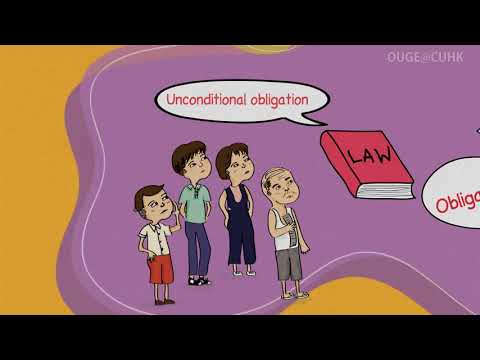
laws all claim that people have

an unconditional obligation to obey them

But if the binding power of the law

is grounded on brute force

can we still say that

we have an unconditional obligation to the law?

For example

suppose that I am robbed by a thief one day

This thief points at me with a knife

and threatens that he would kill me

if I did not pass him my wallet

Do I have an "unconditional obligation"

to pass him my wallet?

According to our moral intuitions

we find it weird to call it an obligation

If someone claims that

we have an obligation in this context

we usually think that the idea of obligation is distorted

Similarly

if someone claims that we are obliged to obey law

because of the brute force behind the law

then he also misinterprets the idea of obligation

The discussion above tells us that

the binding power of the law

cannot be based merely on force

Rather

the binding power of law should be based on authority

which means legitimate power

If the law is legitimate

people will obey it voluntarily and

believe that they have an unconditional obligation to it

Even if a government does not use violence to enforce law

people will still obey law

If the law is grounded on brute force

then people merely have a conditional obligation to obey the law

They have no reason to be a good citizen

when the government overlooks their actions

Therefore

the core question of many political philosophers is:

what is legitimate law that people should obey unconditionally?

For example

in Waiting for the Dawn

Huang Zhongxi claims that the purpose of the law

is not to serve the private interest of a king

but rather to serve the public interest of all people in a society

If a king makes law that

imposes heavy taxation and punishment for his personal enjoyment

he loses the legitimacy of ruling and

people should overthrow this king

An example is King Zhou Wu

overthrowing the tyrannical King Shang-Zhouh

the last emperor of the Shang Dynasty

Huang asserts that in this case

Confucians should abandon their loyalty

and allow the people's revolt

Similarly

the 18th century French philosopher Rousseau asks

in his Social Contract why

if people were born free

are they obliged to obey the law?

Rousseau believes that constitutions are legitimate

only when they pass the legislative process in

a popular assembly in which everyone is equal

The power of the government is regulated by the constitutions

People are ruled by the law

but they are the makers of the law as well

Such law has authority

and people have unconditional obligations to obey it

After the discussions above

let's think

What is the foundation of the law that we are currently obeying?

Apart from the fear of brute force

are there any reasons for us to obey the law?

Không có nhận xét nào:

Đăng nhận xét