Thứ Tư, 28 tháng 3, 2018

Auto news on Youtube Mar 28 2018

- I got this question from Hatem a little while ago.

He said he's been following the tips for a while,

but he loses clients after that initial cold email.

So in today's video I want to run through

his exact email script, the responses he's been getting

from clients

and figure out how do we engage prospects

after the first email.

Let's jump into it.

If we look at his initial cold email

we'll see almost instantly why nobody is responding

or they're disengaging after that first email.

Look at this email that he's sending out.

I was looking for an insurance agent in Los,

and then a big space, Angeles

and came, and then a big space,

across your office.

Your office is doing pretty good

and I was wondering if this could help you.

My name is Hatem.

I am the CEO at Marketing Predator.

I'm gonna stop right there.

We gotta do some stuff right away.

First of all there's no greeting.

There's no hey Marina or hi Marina.

The email is coming from a Gmail address

with no signature

and the company's called Marketing Predator.

Three things off the bat that I would change there:

corporate email address, corporate signature

and customize the first name of the email.

Basic fixes, but the lesson is larger.

First lesson is Hatem thought the problem was

that he wasn't engaging clients after his first email.

We're looking at the first email.

It's actually clear that he was losing them

with the first email.

They're just responding, because it sounds like

they're confused.

My fix for that is asking experts

so Hatem did the right the right thing in reaching out.

Number two is understand how you're perceived.

If you wanna be the CEO of a marketing agency,

you have to act like the CEO of a marketing agency.

That means creating a website,

not calling yourself Marketing Predator.

Somebody who understands marketing

wouldn't have a name like that.

And you can tell from the customer's feedback.

Marina said please send a more formal offer

with your company name and your signature

and that's what's so sad

about this failure that we all go through

when we're building up these cold email campaigns.

This was a client that seems to be interested in marketing.

If she's gonna read this email

and respond to it in it's current state,

this person wants marketing.

They need marketing badly.

So badly that they're willing to give him a second chance

on a bad cold email.

And you can see the same in the other responses.

Here's one from Araceli.

If it has anything to do with marketing,

this will have to go through the agent.

I will go ahead and forward.

I'll let you know if she has any questions.

This comes down to industry knowledge and knowing

which target is right to reach out to,

but he did get a forward and this same feedback's

coming from Kim from this other client.

This would look a little more legit

with a professional signature and email address,

not to mention a link to a website.

Predator indeed.

When your cold emails are so bad

that the client that you're reaching out to

is giving you feedback, actionable feedback

on how to improve, I recommend taking it.

This might seem like an outlier.

You might be asking yourself why I'm presenting this to you

on this YouTube channel, but these are the mistakes

that a lot of us are making.

We might not be making all these mistakes at once,

but I was just on a coaching call

with a client who didn't realize his website was down.

He did everything right:

custom cold email, sending from a company domain.

It looked professional, but when they went to the website

it was down and he was losing meetings, because of it.

I like this example, because he does so much incorrectly,

which helps teach the process.

Are you having issues with your colds emails

or your sales process, anything like that?

If you are, please forward the email chains to

alex@experiment27.com.

Would love to potentially run through your processes

in a future video.

If you found this valuable,

be sure to share it with a friend or two.

We're trying to get 100,000 subs

and every share would be much appreciated.

Also, if you need marketing support,

help with sales systems,

help selling your digital agency

check out experiment27.com.

Thanks.

For more infomation >> Why Do I Lose People After The First Cold Email? 📧Cold Email Teardown📧 - Duration: 3:50.

-------------------------------------------

Why do we call it paradise? - Duration: 2:18.

Hi this is our first video of the channel

I will tell you where we are and what we are doing here.

Why did we choose this place to live

Atlantic Ocean, Canary Islands, Tenerife, Los Cristianos in the south of the island

Tenerife belongs to Spain and the European Union.

There is never winter here.

The touristic season is all year round.

In the south of the island it's normally 10 degrees warmer than in the north.

Population 1 milion.

Plus about 150 000 tourists.

The official language is Spanish but in the south there are many foreigners,

that's why you can speak English here.

In Tenerife there is a sleeping volcano that is the highest mountain in Spain.

In the winter it is often covered with snow, while on the beaches people are sunbathing.

What do we do here?

We spend a lot of time underwater.

We work in a diving center.

In our free time, of course, we dive.

But we also visit interesting places and do different activities.

This is our dive center.

Office desk TV, our students watch the video here

Some equipment for sale Neoprene suits and boots

More suites, fins, regulators BCDs

Kitchen corner Tanks

And compressor room.

Outside we do the briefing and prepare for diving

here we wash and dry the diving equipment

On this channel we will show you our life in Tenerife.

Do not forget to subscribe and watch the Dive Center Daily Live.

For more infomation >> Why do we call it paradise? - Duration: 2:18.

-------------------------------------------

yes, i can spanish. why do you ask? (SUBTITLES RECOMMENDED) - Duration: 4:45.

For more infomation >> yes, i can spanish. why do you ask? (SUBTITLES RECOMMENDED) - Duration: 4:45.

-------------------------------------------

Why Do Some Drugs Make Your Pupils Wider? - Duration: 3:18.

[ ♪ Intro ]

Whether or not eyes are the windows to the soul... scientifically, pupils are the

windows of the eyes.

And sometimes, those windows are more open than usual, like when you've taken a medication

that causes pupil dilation.

Or when people use certain recreational drugs.

It all comes down to how different chemicals can cause changes throughout your whole body,

which can affect little muscles in your eyes.

The pupils are openings that let light into the rest of your eye.

And the colored part of your eye, the iris, controls how much light makes it in.

The balance of two muscle groups in the iris changes how big your pupils are, like a camera aperture.

The iris dilator is arranged like bicycle spokes around the center of your eye.

And when it contracts, it pulls your pupils open wider.

The iris sphincter, on the other hand, is in a ring around your pupil and acts like

most of the sphincter muscles in your body.

It constricts your pupils down to little dots.

So now you know that you've got a sphincter in your eye.

That's just a fact for you.

Anything that blocks or stimulates either muscle can knock that balance out of whack

and cause some really noticeable changes.

For example, drugs that block receptors for the neurotransmitter acetylcholine can cause

impressive dilation.

These medications are designed to inhibit the parasympathetic nervous system, which

controls the involuntary muscle contractions that keep things moving in your body, like

your lungs, or the plumbing that gets rid of waste.

This system also controls the iris sphincter muscle.

So when it's inhibited, the iris sphincter can't counteract the pull from the iris

dilator — and you get wide open, 'blown out' pupils.

Some drugs, like ones for overactive bladders or excessive sweating, target the entire parasympathetic

nervous system.

They often have dilated pupils or blurry vision as side effects, but those aren't the goal.

Others, like the drops used to dilate pupils for eye exams, are more targeted and don't

throw your whole body off.

Now, other drugs can stimulate the sympathetic nervous system, responsible for your body's

'fight-or-flight' response.

And these too can cause dilation.

Take adrenaline, which floods your bloodstream when you're scared but is also a medication

for extreme allergic reactions — it's what's in the EpiPen.

Adrenaline can bind to nerve receptors connected to the iris dilator, making it contract and

pull your pupils open wide.

If people use drugs like cocaine, amphetamines, or even weed, their brains have more dopamine

and norepinephrine floating around.

Usually, either extra neurotransmitters get released, or receptors that naturally suck

them away get blocked by those drugs.

These chemicals are involved in the "high" feeling but also cause dilated pupils.

Scientists think that dopamine makes certain nerve cells release more norepinephrine, which

works like adrenaline to make the iris dilator contract.

So wide pupils can be caused by a lot of things.

But they're a hint that certain chemicals — illicit or not — are bubbling through

your body.

Thanks to our Patreon patrons for asking us great questions like this!

If you want to support us and send us questions, and get some other cool stuff you can go to

patreon.com/scishow.

And if you want to learn more about human eyes, check out our video where I explain

what those pesky little eye floaters actually are.

[ ♪ Outro ]

For more infomation >> Why Do Some Drugs Make Your Pupils Wider? - Duration: 3:18.

-------------------------------------------

Why do Shower Curtains Billow Inwards? - Monthly Mailbag #13 - Duration: 5:47.

For more infomation >> Why do Shower Curtains Billow Inwards? - Monthly Mailbag #13 - Duration: 5:47.

-------------------------------------------

Do you really know why you do what you do? | Petter Johansson - Duration: 16:11.

So why do you think the rich should pay more in taxes?

Why did you buy the latest iPhone?

Why did you pick your current partner?

And why did so many people vote for Donald Trump?

What were the reasons, why did they do it?

So we ask this kind of question all the time,

and we expect to get an answer.

And when being asked, we expect ourselves to know the answer,

to simply tell why we did as we did.

But do we really know why?

So when you say that you prefer George Clooney to Tom Hanks,

due to his concern for the environment,

is that really true?

So you can be perfectly sincere and genuinely believe

that this is the reason that drives your choice,

but to me, it may still feel like something is missing.

As it stands, due to the nature of subjectivity,

it is actually very hard to ever prove that people are wrong about themselves.

So I'm an experimental psychologist,

and this is the problem we've been trying to solve in our lab.

So we wanted to create an experiment

that would allow us to challenge what people say about themselves,

regardless of how certain they may seem.

But tricking people about their own mind is hard.

So we turned to the professionals.

The magicians.

So they're experts at creating the illusion of a free choice.

So when they say, "Pick a card, any card,"

the only thing you know is that your choice is no longer free.

So we had a few fantastic brainstorming sessions

with a group of Swedish magicians,

and they helped us create a method

in which we would be able to manipulate the outcome of people's choices.

This way we would know when people are wrong about themselves,

even if they don't know this themselves.

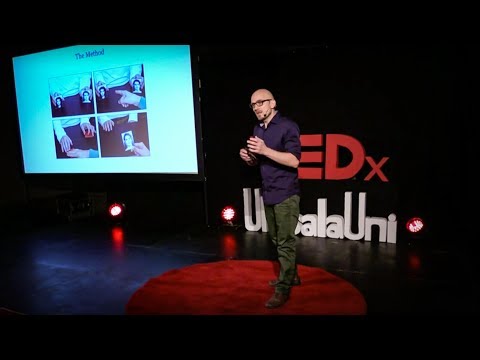
So I will now show you a short movie showing this manipulation.

So it's quite simple.

The participants make a choice,

but I end up giving them the opposite.

And then we want to see: How did they react, and what did they say?

So it's quite simple, but see if you can spot the magic going on.

And this was shot with real participants, they don't know what's going on.

(Video) Petter Johansson: Hi, my name's Petter.

Woman: Hi, I'm Becka.

PJ: I'm going to show you pictures like this.

And you'll have to decide which one you find more attractive.

Becka: OK.

PJ: And then sometimes, I will ask you why you prefer that face.

Becka: OK.

PJ: Ready? Becka: Yeah.

PJ: Why did you prefer that one?

Becka: The smile, I think.

PJ: Smile.

Man: One on the left.

Again, this one just struck me.

Interesting shot.

Since I'm a photographer, I like the way it's lit and looks.

Petter Johansson: But now comes the trick.

(Video) Woman 1: This one.

PJ: So they get the opposite of their choice.

And let's see what happens.

Woman 2: Um ...

I think he seems a little more innocent than the other guy.

Man: The one on the left.

I like her smile and contour of the nose and face.

So it's a little more interesting to me, and her haircut.

Woman 3: This one.

I like the smirky look better.

PJ: You like the smirky look better?

(Laughter)

Woman 3: This one.

PJ: What made you choose him?

Woman 3: I don't know, he looks a little bit like the Hobbit.

(Laughter)

PJ: And what happens in the end

when I tell them the true nature of the experiment?

Yeah, that's it. I just have to ask a few questions.

Man: Sure.

PJ: What did you think of this experiment, was it easy or hard?

Man: It was easy.

PJ: During the experiments,

I actually switched the pictures three times.

Was this anything you noticed?

Man: No. I didn't notice any of that.

PJ: Not at all? Man: No.

Switching the pictures as far as ...

PJ: Yeah, you were pointing at one of them but I actually gave you the opposite.

Man: The opposite one. OK, when you --

No. Shows you how much my attention span was.

(Laughter)

PJ: Did you notice that sometimes during the experiment

I switched the pictures?

Woman 2: No, I did not notice that.

PJ: You were pointing at one, but then I gave you the other one.

No inclination of that happening?

Woman 2: No.

Woman 2: I did not notice.

(Laughs)

PJ: Thank you.

Woman 2: Thank you.

PJ: OK, so as you probably figured out now,

the trick is that I have two cards in each hand,

and when I hand one of them over,

the black one kind of disappears into the black surface on the table.

So using pictures like this,

normally not more than 20 percent of the participants detect these tries.

And as you saw in the movie,

when in the end we explain what's going on,

they're very surprised and often refuse to believe the trick has been made.

So this shows that this effect is quite robust and a genuine effect.

But if you're interested in self-knowledge, as I am,

the more interesting bit is,

OK, so what did they say when they explained these choices?

So we've done a lot of analysis

of the verbal reports in these experiments.

And this graph simply shows

that if you compare what they say in a manipulated trial

with a nonmanipulated trial,

that is when they explain a normal choice they've made

and one where we manipulated the outcome,

we find that they are remarkably similar.

So they are just as emotional, just as specific,

and they are expressed with the same level of certainty.

So the strong conclusion to draw from this

is that if there are no differences

between a real choice and a manipulated choice,

perhaps we make things up all the time.

But we've also done studies

where we try to match what they say with the actual faces.

And then we find things like this.

So here, this male participant, he preferred the girl to the left,

he ended up with the one to the right.

And then, he explained his choice like this.

"She is radiant.

I would rather have approached her at the bar than the other one.

And I like earrings."

And whatever made him choose the girl on the left to begin with,

it can't have been the earrings,

because they were actually sitting on the girl on the right.

So this is a clear example of a post hoc construction.

So they just explained the choice afterwards.

So what this experiment shows is,

OK, so if we fail to detect that our choices have been changed,

we will immediately start to explain them in another way.

And what we also found

is that the participants often come to prefer the alternative,

that they were led to believe they liked.

So if we let them do the choice again,

they will now choose the face they had previously rejected.

So this is the effect we call "choice blindness."

And we've done a number of different studies --

we've tried consumer choices,

choices based on taste and smell and even reasoning problems.

But what you all want to know is of course

does this extend also to more complex, more meaningful choices?

Like those concerning moral and political issues.

So the next experiment, it needs a little bit of a background.

So in Sweden, the political landscape

is dominated by a left-wing and a right-wing coalition.

And the voters may move a little bit between the parties within each coalition,

but there is very little movement between the coalitions.

And before each elections,

the newspapers and the polling institutes

put together what they call "an election compass"

which consists of a number of dividing issues

that sort of separates the two coalitions.

Things like if tax on gasoline should be increased

or if the 13 months of paid parental leave

should be split equally between the two parents

in order to increase gender equality.

So, before the last Swedish election,

we created an election compass of our own.

So we walked up to people in the street

and asked if they wanted to do a quick political survey.

So first we had them state their voting intention

between the two coalitions.

Then we asked them to answer 12 of these questions.

They would fill in their answers,

and we would ask them to discuss,

so OK, why do you think tax on gas should be increased?

And we'd go through the questions.

Then we had a color coded template

that would allow us to tally their overall score.

So this person would have one, two, three, four

five, six, seven, eight, nine scores to the left,

so he would lean to the left, basically.

And in the end, we also had them fill in their voting intention once more.

But of course, there was also a trick involved.

So first, we walked up to people,

we asked them about their voting intention

and then when they started filling in,

we would fill in a set of answers going in the opposite direction.

We would put it under the notepad.

And when we get the questionnaire,

we would simply glue it on top of the participant's own answer.

So there, it's gone.

And then we would ask about each of the questions:

How did you reason here?

And they'll state the reasons,

together we will sum up their overall score.

And in the end, they will state their voting intention again.

So what we find first of all here,

is that very few of these manipulations are detected.

And they're not detected in the sense that they realize,

"OK, you must have changed my answer,"

it was more the case that,

"OK, I must've misunderstood the question the first time I read it.

Can I please change it?"

And even if a few of these manipulations were changed,

the overall majority was missed.

So we managed to switch 90 percent of the participants' answers

from left to right, right to left, their overall profile.

And what happens then when they are asked to motivate their choices?

And here we find much more interesting verbal reports

than compared to the faces.

People say things like this, and I'll read it to you.

So, "Large-scale governmental surveillance of email and internet traffic

ought to be permissible as means to combat international crime and terrorism."

"So you agree to some extent with this statement." "Yes."

"So how did you reason here?"

"Well, like, as it is so hard to get at international crime and terrorism,

I think there should be those kinds of tools."

And then the person remembers an argument from the newspaper in the morning.

"Like in the newspaper today,

it said they can like, listen to mobile phones from prison,

if a gang leader tries to continue his crimes from inside.

And I think it's madness that we have so little power

that we can't stop those things

when we actually have the possibility to do so."

And then there's a little bit back and forth in the end:

"I don't like that they have access to everything I do,

but I still think it's worth it in the long run."

So, if you didn't know that this person

just took part in a choice blindness experiment,

I don't think you would question

that this is the true attitude of that person.

And what happens in the end, with the voting intention?

What we find -- that one is also clearly affected by the questionnaire.

So we have 10 participants

shifting from left to right or from right to left.

We have another 19 that go from clear voting intention

to being uncertain.

Some go from being uncertain to clear voting intention.

And then there is a number of participants staying uncertain throughout.

And that number is interesting

because if you look at what the polling institutes say

the closer you get to an election,

the only people that are sort of in play

are the ones that are considered uncertain.

But we show there is a much larger number

that would actually consider shifting their attitudes.

And here I must point out, of course, that you are not allowed to use this

as an actual method to change people's votes

before an election,

and we clearly debriefed them afterwards

and gave them every opportunity to change back

to whatever they thought first.

But what this shows is that if you can get people

to see the opposite view and engage in a conversation with themselves,

that could actually make them change their views.

OK.

So what does it all mean?

What do I think is going on here?

So first of all,

a lot of what we call self-knowledge is actually self-interpretation.

So I see myself make a choice,

and then when I'm asked why,

I just try to make as much sense of it as possible

when I make an explanation.

But we do this so quickly and with such ease

that we think we actually know the answer when we answer why.

And as it is an interpretation,

of course we sometimes make mistakes.

The same way we make mistakes when we try to understand other people.

So beware when you ask people the question "why"

because what may happen is that, if you asked them,

"So why do you support this issue?"

"Why do you stay in this job or this relationship?" --

what may happen when you ask why is that you actually create an attitude

that wasn't there before you asked the question.

And this is of course important in your professional life, as well,

or it could be.

If, say, you design something and then you ask people,

"Why do you think this is good or bad?"

Or if you're a journalist asking a politician,

"So, why did you make this decision?"

Or if indeed you are a politician

and try to explain why a certain decision was made.

So this may all seem a bit disturbing.

But if you want to look at it from a positive direction,

it could be seen as showing,

OK, so we're actually a little bit more flexible than we think.

We can change our minds.

Our attitudes are not set in stone.

And we can also change the minds of others,

if we can only get them to engage with the issue

and see it from the opposite view.

And in my own personal life, since starting with this research --

So my partner and I, we've always had the rule

that you're allowed to take things back.

Just because I said I liked something a year ago,

doesn't mean I have to like it still.

And getting rid of the need to stay consistent

is actually a huge relief and makes relational life so mush easier to live.

Anyway, so the conclusion must be:

know that you don't know yourself.

Or at least not as well as you think you do.

Thanks.

(Applause)

For more infomation >> Do you really know why you do what you do? | Petter Johansson - Duration: 16:11.

-------------------------------------------

Why do media ignore illegal immigrant crime stories? - Duration: 11:07.

For more infomation >> Why do media ignore illegal immigrant crime stories? - Duration: 11:07.

-------------------------------------------

Blue Promise: Why are Maternal Deaths on the Rise in Texas - Duration: 2:54.

[Music]

DR. McCOY: Texas has the highest maternal mortality

rate in the developed world. That's a shocking statement

and here today I'm with Dr. Esteban Lopez

on Blue Promise to talk a little bit

about this recent study talking about

maternal mortality in Texas.

Dr. Lopez welcome.

DR. LOPEZ: Thank you Dr. McCoy

Well this is something that's very

concerning to me as a physician

and to the entire state of Texas.

We have some alarming numbers in the state,

nearly 36 per hundred thousand women die from

a complication of childbirth and that's a death within

the one year of delivering that's not related to an

accident or cancer secondary to being pregnant.

DR. McCOY: Now I let off with a pretty provocative

statement though that this is worst than the

developed world so give me some examples.

DR. LOPEZ: Absolutely so I said 36 per hundred thousand.

In Poland it's three per hundred thousand.

In Japan it's five per hundred thousand.

So Texas is an outlier at nearly 36 per hundred thousand.

DR. McCOY: So why what's the cause

DR. LOPEZ: Well there's a variety of

different reasons that we're attributing

to this now also this is a problem

throughout the United States but even within

the United States the Texas has the highest

number so in the United States maternal mortality

has been rising between 2000 and 2014.

California for instance is at 7 per 100,000,

we are seeing that deferring child birth to later age,

complications from chronic conditions such as obesity,

diabetes, and high blood pressure

contribute to maternal mortality and

then the rise in cesarean sections and

complications related to those.

Now California had higher numbers previously

and they put a collaborative together

to address that such as having

stocked carts, hemorrhage carts,

getting tools to nurses and doctors to be able

to deal with life-threatening

complications at the time of delivery.

Now the state of Texas has done something similar recently.

DR. McCOY: So when I looked at the report from the

task force one thing really stood out for me and that is

there are certain races where this is a

significant problem.

DR. LOPEZ: Absolutely so we know that 11 percent of the

births in the state of Texas are through

African-American women but African-American women

have significantly higher rates of mortality

associated with childbirth and if I take a look at my

notes we're seeing that African-American women are

nearly 30% of the folks that are being affected

through maternal mortality.

DR. McCOY: Dr. Lopez thanks for being here

today and walking us through this pretty

complicated subject and thanks for being here for

this episode of Blue Promise.

[Music]

For more infomation >> Blue Promise: Why are Maternal Deaths on the Rise in Texas - Duration: 2:54.

-------------------------------------------

Want Better SEO Results? Why a Full Backlink Audit Will Help You - Duration: 1:28.

Here's a question I get quite often

"Christoph, why should we audit all the backlinks?"

"Why do you force me to work so hard, to spend more money to audit my 50 million backlinks?"

Here is a simple answer:

Because you have to, because we have to

there's no point in looking just at 500,000 of these backlinks

think about it - that's what?

1%?

Yeah

you don't simply make business decisions

with 1% of the data do you?

You don't take your car to service and

make them look at your front lights only

you wanna full check

you expect it

you expect it from the professional, and in this case

we are the professionals for links and link audits

and my recommendation is

do it all or nothing

if you seriously consider just big decisions

based on 1% of the data

I'm sorry, then we can't help you anymore

I changed this and I'm happy to do so

I'm happy and proud about this decision that we don't offer any partial link data any more

and it might change again

we might find more data in the future

my goal is to provide you with the biggest, best

and richest backlink profile that you can get

this is what LinkResearchTools stands for

Thank you

Không có nhận xét nào:

Đăng nhận xét