So why do you think the rich should pay more in taxes?
Why did you buy the latest iPhone?
Why did you pick your current partner?
And why did so many people vote for Donald Trump?
What were the reasons, why did they do it?
So we ask this kind of question all the time,
and we expect to get an answer.
And when being asked, we expect ourselves to know the answer,
to simply tell why we did as we did.
But do we really know why?
So when you say that you prefer George Clooney to Tom Hanks,
due to his concern for the environment,
is that really true?
So you can be perfectly sincere and genuinely believe
that this is the reason that drives your choice,
but to me, it may still feel like something is missing.
As it stands, due to the nature of subjectivity,
it is actually very hard to ever prove that people are wrong about themselves.
So I'm an experimental psychologist,
and this is the problem we've been trying to solve in our lab.
So we wanted to create an experiment
that would allow us to challenge what people say about themselves,
regardless of how certain they may seem.
But tricking people about their own mind is hard.
So we turned to the professionals.
The magicians.
So they're experts at creating the illusion of a free choice.
So when they say, "Pick a card, any card,"
the only thing you know is that your choice is no longer free.
So we had a few fantastic brainstorming sessions
with a group of Swedish magicians,
and they helped us create a method
in which we would be able to manipulate the outcome of people's choices.
This way we would know when people are wrong about themselves,
even if they don't know this themselves.
So I will now show you a short movie showing this manipulation.
So it's quite simple.
The participants make a choice,
but I end up giving them the opposite.
And then we want to see: How did they react, and what did they say?
So it's quite simple, but see if you can spot the magic going on.
And this was shot with real participants, they don't know what's going on.
(Video) Petter Johansson: Hi, my name's Petter.
Woman: Hi, I'm Becka.
PJ: I'm going to show you pictures like this.
And you'll have to decide which one you find more attractive.
Becka: OK.
PJ: And then sometimes, I will ask you why you prefer that face.
Becka: OK.
PJ: Ready? Becka: Yeah.
PJ: Why did you prefer that one?
Becka: The smile, I think.
PJ: Smile.
Man: One on the left.
Again, this one just struck me.
Interesting shot.
Since I'm a photographer, I like the way it's lit and looks.
Petter Johansson: But now comes the trick.
(Video) Woman 1: This one.
PJ: So they get the opposite of their choice.
And let's see what happens.
Woman 2: Um ...
I think he seems a little more innocent than the other guy.
Man: The one on the left.
I like her smile and contour of the nose and face.
So it's a little more interesting to me, and her haircut.
Woman 3: This one.
I like the smirky look better.
PJ: You like the smirky look better?
(Laughter)
Woman 3: This one.
PJ: What made you choose him?
Woman 3: I don't know, he looks a little bit like the Hobbit.
(Laughter)
PJ: And what happens in the end
when I tell them the true nature of the experiment?
Yeah, that's it. I just have to ask a few questions.
Man: Sure.
PJ: What did you think of this experiment, was it easy or hard?
Man: It was easy.
PJ: During the experiments,
I actually switched the pictures three times.
Was this anything you noticed?
Man: No. I didn't notice any of that.
PJ: Not at all? Man: No.
Switching the pictures as far as ...
PJ: Yeah, you were pointing at one of them but I actually gave you the opposite.
Man: The opposite one. OK, when you --
No. Shows you how much my attention span was.
(Laughter)
PJ: Did you notice that sometimes during the experiment
I switched the pictures?
Woman 2: No, I did not notice that.
PJ: You were pointing at one, but then I gave you the other one.
No inclination of that happening?
Woman 2: No.
Woman 2: I did not notice.
(Laughs)
PJ: Thank you.
Woman 2: Thank you.
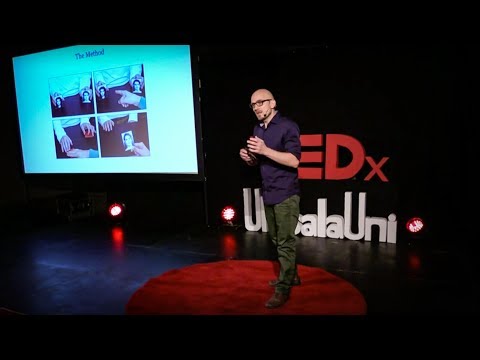
PJ: OK, so as you probably figured out now,
the trick is that I have two cards in each hand,
and when I hand one of them over,
the black one kind of disappears into the black surface on the table.
So using pictures like this,
normally not more than 20 percent of the participants detect these tries.
And as you saw in the movie,
when in the end we explain what's going on,
they're very surprised and often refuse to believe the trick has been made.
So this shows that this effect is quite robust and a genuine effect.
But if you're interested in self-knowledge, as I am,
the more interesting bit is,
OK, so what did they say when they explained these choices?
So we've done a lot of analysis
of the verbal reports in these experiments.
And this graph simply shows
that if you compare what they say in a manipulated trial
with a nonmanipulated trial,
that is when they explain a normal choice they've made
and one where we manipulated the outcome,
we find that they are remarkably similar.
So they are just as emotional, just as specific,
and they are expressed with the same level of certainty.
So the strong conclusion to draw from this
is that if there are no differences
between a real choice and a manipulated choice,
perhaps we make things up all the time.
But we've also done studies
where we try to match what they say with the actual faces.
And then we find things like this.
So here, this male participant, he preferred the girl to the left,
he ended up with the one to the right.
And then, he explained his choice like this.
"She is radiant.
I would rather have approached her at the bar than the other one.
And I like earrings."
And whatever made him choose the girl on the left to begin with,
it can't have been the earrings,
because they were actually sitting on the girl on the right.
So this is a clear example of a post hoc construction.
So they just explained the choice afterwards.
So what this experiment shows is,
OK, so if we fail to detect that our choices have been changed,
we will immediately start to explain them in another way.
And what we also found
is that the participants often come to prefer the alternative,
that they were led to believe they liked.
So if we let them do the choice again,
they will now choose the face they had previously rejected.
So this is the effect we call "choice blindness."
And we've done a number of different studies --
we've tried consumer choices,
choices based on taste and smell and even reasoning problems.
But what you all want to know is of course
does this extend also to more complex, more meaningful choices?
Like those concerning moral and political issues.
So the next experiment, it needs a little bit of a background.
So in Sweden, the political landscape
is dominated by a left-wing and a right-wing coalition.
And the voters may move a little bit between the parties within each coalition,
but there is very little movement between the coalitions.
And before each elections,
the newspapers and the polling institutes
put together what they call "an election compass"
which consists of a number of dividing issues
that sort of separates the two coalitions.
Things like if tax on gasoline should be increased
or if the 13 months of paid parental leave
should be split equally between the two parents
in order to increase gender equality.
So, before the last Swedish election,
we created an election compass of our own.
So we walked up to people in the street
and asked if they wanted to do a quick political survey.
So first we had them state their voting intention
between the two coalitions.
Then we asked them to answer 12 of these questions.
They would fill in their answers,
and we would ask them to discuss,
so OK, why do you think tax on gas should be increased?
And we'd go through the questions.
Then we had a color coded template
that would allow us to tally their overall score.
So this person would have one, two, three, four
five, six, seven, eight, nine scores to the left,
so he would lean to the left, basically.
And in the end, we also had them fill in their voting intention once more.
But of course, there was also a trick involved.
So first, we walked up to people,
we asked them about their voting intention
and then when they started filling in,
we would fill in a set of answers going in the opposite direction.
We would put it under the notepad.
And when we get the questionnaire,
we would simply glue it on top of the participant's own answer.
So there, it's gone.
And then we would ask about each of the questions:
How did you reason here?
And they'll state the reasons,
together we will sum up their overall score.
And in the end, they will state their voting intention again.
So what we find first of all here,
is that very few of these manipulations are detected.
And they're not detected in the sense that they realize,
"OK, you must have changed my answer,"
it was more the case that,
"OK, I must've misunderstood the question the first time I read it.
Can I please change it?"
And even if a few of these manipulations were changed,
the overall majority was missed.
So we managed to switch 90 percent of the participants' answers
from left to right, right to left, their overall profile.
And what happens then when they are asked to motivate their choices?
And here we find much more interesting verbal reports
than compared to the faces.
People say things like this, and I'll read it to you.
So, "Large-scale governmental surveillance of email and internet traffic
ought to be permissible as means to combat international crime and terrorism."
"So you agree to some extent with this statement." "Yes."
"So how did you reason here?"
"Well, like, as it is so hard to get at international crime and terrorism,
I think there should be those kinds of tools."
And then the person remembers an argument from the newspaper in the morning.
"Like in the newspaper today,
it said they can like, listen to mobile phones from prison,
if a gang leader tries to continue his crimes from inside.
And I think it's madness that we have so little power
that we can't stop those things
when we actually have the possibility to do so."
And then there's a little bit back and forth in the end:
"I don't like that they have access to everything I do,
but I still think it's worth it in the long run."
So, if you didn't know that this person
just took part in a choice blindness experiment,
I don't think you would question
that this is the true attitude of that person.
And what happens in the end, with the voting intention?
What we find -- that one is also clearly affected by the questionnaire.
So we have 10 participants
shifting from left to right or from right to left.
We have another 19 that go from clear voting intention
to being uncertain.
Some go from being uncertain to clear voting intention.
And then there is a number of participants staying uncertain throughout.
And that number is interesting
because if you look at what the polling institutes say
the closer you get to an election,
the only people that are sort of in play
are the ones that are considered uncertain.
But we show there is a much larger number
that would actually consider shifting their attitudes.
And here I must point out, of course, that you are not allowed to use this
as an actual method to change people's votes
before an election,
and we clearly debriefed them afterwards
and gave them every opportunity to change back
to whatever they thought first.
But what this shows is that if you can get people
to see the opposite view and engage in a conversation with themselves,
that could actually make them change their views.
OK.
So what does it all mean?
What do I think is going on here?
So first of all,
a lot of what we call self-knowledge is actually self-interpretation.
So I see myself make a choice,
and then when I'm asked why,
I just try to make as much sense of it as possible
when I make an explanation.
But we do this so quickly and with such ease
that we think we actually know the answer when we answer why.
And as it is an interpretation,
of course we sometimes make mistakes.
The same way we make mistakes when we try to understand other people.
So beware when you ask people the question "why"
because what may happen is that, if you asked them,
"So why do you support this issue?"
"Why do you stay in this job or this relationship?" --
what may happen when you ask why is that you actually create an attitude
that wasn't there before you asked the question.
And this is of course important in your professional life, as well,
or it could be.
If, say, you design something and then you ask people,
"Why do you think this is good or bad?"
Or if you're a journalist asking a politician,
"So, why did you make this decision?"
Or if indeed you are a politician
and try to explain why a certain decision was made.
So this may all seem a bit disturbing.
But if you want to look at it from a positive direction,
it could be seen as showing,
OK, so we're actually a little bit more flexible than we think.
We can change our minds.
Our attitudes are not set in stone.
And we can also change the minds of others,
if we can only get them to engage with the issue
and see it from the opposite view.
And in my own personal life, since starting with this research --
So my partner and I, we've always had the rule
that you're allowed to take things back.
Just because I said I liked something a year ago,
doesn't mean I have to like it still.
And getting rid of the need to stay consistent
is actually a huge relief and makes relational life so mush easier to live.
Anyway, so the conclusion must be:
know that you don't know yourself.
Or at least not as well as you think you do.
Thanks.
(Applause)




Không có nhận xét nào:
Đăng nhận xét